What do you think of when you see a semicolon? To most people, it’s just another punctuation mark in the English language, a lonely dot with a funny little tail dangling beneath it. Small. Forgettable. Often misunderstood. Many people don’t even know how to use it correctly. What purpose does it really serve?
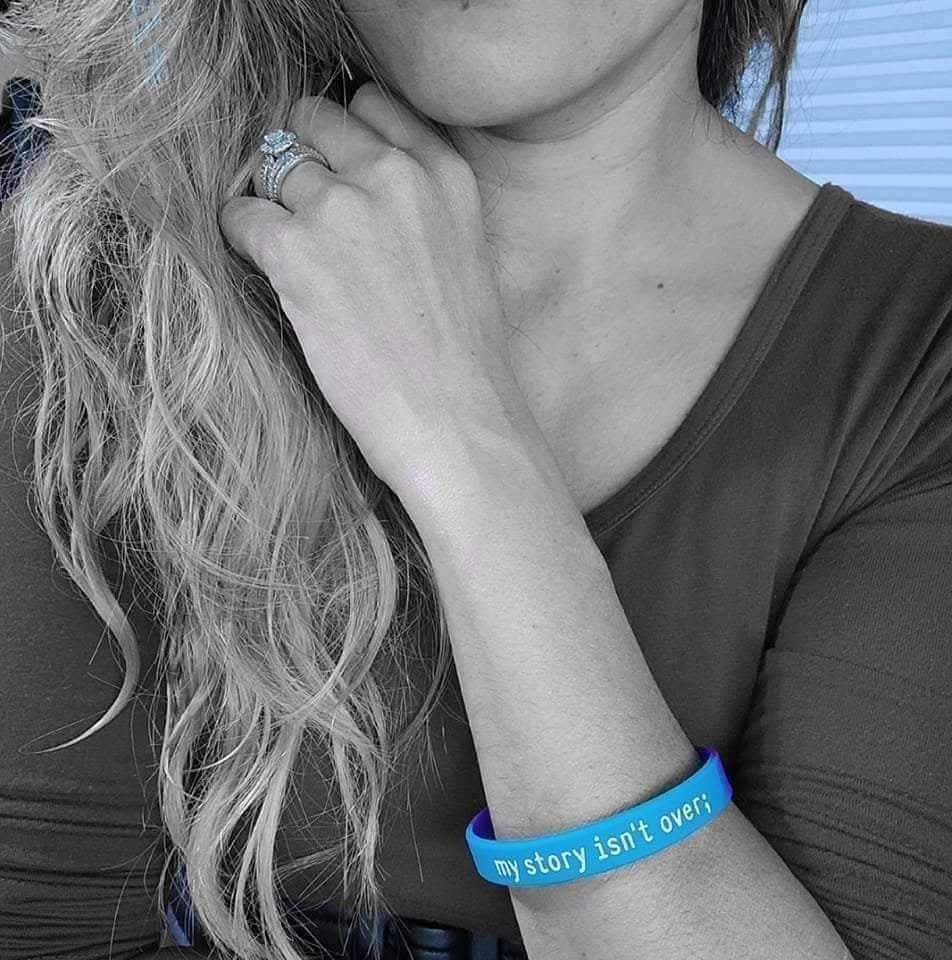
If you look closely, it’s actually a period sitting on top of a comma. And that matters. In writing, a semicolon is used when the author could have ended the sentence… but chose not to. It represents a pause without a full stop. A breath, not a goodbye. A decision to keep going when stopping would have been easier.
And for me, that’s exactly why the semicolon is my favorite punctuation mark.
I know that might sound silly at first. But to me, it isn’t about grammar rules or sentence structure. For those like me, who have struggled with mental health, it’s about survival. It’s about choosing to continue when life is heavy, when your heart is tired, and when your story feels too painful to keep writing. It’s about the moments when everything inside of you wants to put a period at the end of your story, but somehow, by grace, by strength you didn’t know you had, by God’s quiet whisper reminding you of your worth, you choose a semicolon instead.
I have always believed that my writing should reflect who I truly am: raw, honest, and unfiltered. What you’re about to read comes from the deepest parts of my heart and shares pieces of my story that are tender, painful, and deeply personal. Some of the topics discussed include eating disorders, depression, sexual assault, self-harm, and suicidal thoughts, which may be difficult for some readers.
I share this not for shock, but for healing. I believe with my whole heart that God redeems what is broken, restores what has been shattered, and uses our darkest chapters for His glory. If my story helps even one person feel less alone, more seen, or reminded that God is still near in the midst of their pain, then sharing it is worth it.
Please read with grace, prayer, and an open heart.
My first real battle with mental health and depression began in seventh grade, after enduring years of relentless bullying that followed me from kindergarten all the way until high school. I struggled with learning challenges from an early age, and because of that, my parents made the decision to enroll me in the Catholic school system from first through eighth grade. Their intentions were pure; they believed a faith-based environment would offer me grace, patience, and compassion. Instead, I experienced the exact opposite (read my blog “Sticks and Stones” for more on this topic).
I was told by multiple teachers that I would never make it past eighth grade, that high school, and any future beyond it, was out of reach for someone like me. My grades and my classroom performance suffered, and I was that kid that no teacher wanted in their class.
I was that kid who back-talked with so much sass, who didn’t want to do anything that was asked of me, I constantly questioned authority, could not follow directions, and was constantly on the move. There was a time the teachers took a group of us to the bathroom (To this day I’m still not quite sure why us second graders were not allowed to go to the bathroom by ourselves) and instead of going into the stall, I ran as fast as my little legs could carry me and made my teachers chase me around the building. Why? I’m still trying to figure that one out. I know I was a big question mark back then and in a lot of ways, I still am. I often joke that I honestly have no idea why I do half the things I do, but that’s neither here nor there.
Even so, I had a way of puzzling my teachers. Even though “F” seemed to be my favorite letter at the time, and “a constant disruption to the class” was the phrase of choice that decorated my report cards, I consistently scored in the 99th percentile on standardized tests in reading and language arts. Instead of asking why there was such a disconnect, the solution was simple and fast: label me and medicate me. In second grade, I was placed on a medication to treat Attention Deficit Hyperactivity Disorder (though that diagnosis was not widely known at the time so I was not formally diagnosed as a child) and, in many ways, left to the wolves. I was placed into accelerated reading groups, yet my parents were told that because of my behaviors, investing in anything beyond that “wasn’t worth it.” The message was clear: I wasn’t expected to go far.
The dosage of Ritalin I was put on was so high that the lively, sassy, curious, funny, can’t-sit-still-to-save-my-life version of me slowly disappeared. I became a shell of myself. I sat. I stared. I existed, but I wasn’t living. The sparkle, the energy, the little girl who loved to move and laugh and talk was muted into silence.
Then, in fourth grade, everything changed. I was blessed with a teacher I still kept in touch with well into college, a woman who chose to see me instead of my behaviors. She took the time to know my family, to understand my world, and to look beneath the labels that followed me from classroom to classroom. She went far beyond what was “required” of her as a teacher. She invited my family to dinners and holidays. She learned my interests, my fears, my quirks. And through all of that, she realized something no one else seemed willing to see: I wasn’t a “bad kid.” I was a hurting kid. A child desperate to be noticed, even if that meant acting out just to feel seen. A child who would do anything for any kind of attention, even if it was negative.
Because of her advocacy and guidance, I was eventually taken off my medication. And slowly, the real me came back to life. The energy returned. The light returned. For the first time in a long time, I was finally allowed to be myself again.
As I got older, “being myself” seemed to get me into even more trouble. My need for attention and my impulsivity only intensified, and instead of being understood, I was pushed further to the margins. In fifth grade, while my peers were starting to date and experience their first relationships, no boy wanted to be seen with me. I was never asked to attend school dances. I was never chosen as someone’s girlfriend. I never got to experience a first kiss when everyone else seemed to move on without me. I learned what it felt like to be overlooked, not just socially, but emotionally.
At one point, the school principal sat across from my mother and said, without hesitation, that she believed I belonged in an institution for children with severe behavioral issues because they could not help me there. Those words didn’t just sting in the moment. They sank deep, planting seeds of shame and self-doubt that I would carry for years. Because of this, I learned that being myself was something to be ashamed of. Something to bury deep beneath the surface and never allow the world to see.
Thankfully, my parents eventually realized how deeply wrong that environment had been for me and made the decision to transfer me to a public high school. While the bullying had eased, the damage to my identity and self-worth had already been done. I carried a constant ache of feeling “not enough,” convinced that no matter how hard I tried, I would never measure up to the expectations placed on me.
I met a few genuinely good people who tried to talk to me about God, but I mostly shut them out because of my experiences within the Catholic school system. Some of their words still managed to reach me, whispering truths I desperately needed to hear. Yet deep down, I didn’t believe I was worthy of God’s love or forgiveness. I had been conditioned to see myself as broken, sinful, and undeserving, convinced that I was simply a bad person.
Desperate to find belonging in other ways, I threw myself into extracurricular activities in hopes of building new connections and discovering who I was supposed to be. That’s when I found theater. On stage, I could be anyone but myself and exist anywhere but my own reality, and at the time, that escape felt like safety. The stage became my refuge. I poured my heart into every role and eventually added choir into the mix, something that had been part of me since childhood. Performing gave me permission to breathe again, even when the rest of my life felt heavy and uncertain.
Music has always been a part of my life; I learned to play the piano and violin in first grade, and from fifth grade on, I was constantly singing. All through high school and into college, I was always part of some kind of choral group. As my mental health struggles began to creep into every corner of my life, music became my lifeline. I would lose myself in lyrics, melodies, rhythms, and harmonies: an out-of-body experience that gave me relief from the constant noise in my mind. Standing on stage, singing or playing in front of crowds, brought moments of joy that felt rare and sacred during a season when so much of me felt numb and broken.
In high school, I was the girl who stayed home on weekends, buried in books, while everyone else seemed to be out living the “normal” teenage experience. Being raised by traditional Asian parents while growing up in American culture created a constant tug-of-war inside me. The cultural clash was overwhelming, and at the time, it bred resentment. I felt misunderstood, like I was constantly trying to become someone they couldn’t see and struggling to live up to an image that never quite fit.
While I was desperately trying to survive the battle raging inside my own mind, a much larger war was quietly closing in around me. Everything in my life felt uncontrollable. My emotions, my identity, my sense of worth, my future. I felt powerless, invisible, and unheard. So I fought back in the only way my seventeen-year-old brain knew how at the time: by trying to take control of the one thing I thought I could: my body. What started as a desperate attempt to regain some sense of power quickly became something far darker and far more dangerous than I ever imagined.
My struggle with anorexia and disordered eating began during my junior year of high school and followed me well into my college years and beyond. At first, it looked harmless on the surface. I started skipping meals. I told myself I “just wasn’t hungry.” I ate smaller portions and found excuses not to sit down at the table. My parents assumed it was stress due to the pressures of school, extracurriculars, and college prep, and at the time, so did I. But what they couldn’t see was the quiet obsession growing inside my head. The numbers, the guilt, the shame, the constant internal voice telling me I wasn’t thin enough, disciplined enough, good enough.
By the time I stopped eating almost entirely, the damage was undeniable. My body had become weak, fragile, and unrecognizable. During my senior year of high school, I weighed just 83 pounds. I was running on fumes, surviving on emptiness, yet somehow still forcing myself to function, smile, perform, and pretend everything was fine. My teachers began to notice and mentioned things in passing but they never truly dug deep below the surface to understand the extent of what was going on. And, even if they did, I did not have the words back then to verbalize what I was feeling or why I was doing it.
What I didn’t realize then was that I wasn’t gaining control at all. I was losing myself. Piece by piece, bite by bite, I was disappearing, yet I felt empowered because I had convinced myself I was finally in control of something, even if that something was slowly killing me. In the end, it didn’t make me stronger. It left me weaker, lonelier, and more shattered than I had ever been before.
Despite everything, the labels, the low expectations, and the odds stacked against me, the girl who was once told she would never make it, proved them wrong. I graduated from high school with honors, and, the following fall, began attending Miami University of Ohio, often referred to as the Ivy League of the Midwest.
This, however, was not my decision. I wanted to attend The Ohio State University, where my then boyfriend had been accepted, but my parents insisted that I attend Miami. They had hopes and dreams for me, which trumped my own. I wanted to go to college for journalism and writing, something that also brought me so much joy, but instead, I was made to enrolled as an Accounting major, which I absolutely hated.
The moment I arrived on campus that fall, I felt a rush of newfound freedom. For the first time, I was no longer living under my parents’ proverbial thumbs, and I felt alive. I had started to grow out of my awkward phase during my junior year of high school, discovered makeup, and learned how to highlight my features and step into a new sense of confidence.
I started to embrace the attention I was starting to receive from guys, and in my active rebellion, also discovered the world of drugs and alcohol. I found that the more I drank, the more the guys wanted to be around me, which only fueled the fire.
I met so many new people who I felt not only accepted me but also understood me. I fell into the party scene and got caught up with the wrong crowd, seeking attention in all the wrong places. There were many nights I would enjoy the company of whatever man would give me the sort of attention I craved, only to be left feeling alone and even emptier the next day.
By my second year, just shy of my 21st birthday, my drinking had spiraled so far out of control that I was placed on academic suspension for an entire semester and required to enroll in an outpatient rehab program before I could return. I moved in with a friend who lived off campus, and we continued to drink and party. Eventually, she kicked me out because my drinking had gotten so out of control, and so I had no choice but to move back in with my parents in Columbus.
Living at home felt so unbearable that I threw everything I had into meeting the requirements placed in front of me. I wasn’t interested in quitting drinking, I just wanted my life back. I wanted to return to campus, to some version of normalcy, to independence, and to the friends who made me feel like I finally belonged. So I went through the motions, showed up to the meetings, and checked the boxes, all without truly listening or caring about what anyone had to say.
Once I returned to campus the following semester, I spiraled even deeper into depression. The numbness became so heavy that I fell back into the same destructive patterns, chasing brief moments of relief that never lasted and always left me feeling emptier than before.
My behavior was often misread as an invitation, and even when I said no, men chose not to hear it. My “no” became a challenge to them, twisted into a game of playing hard to get. Shortly after I returned to campus my second year, I was sexually assaulted for the first time. For a long time afterward, I carried the blame on my own shoulders because we were both intoxicated. I tortured myself with thoughts like, “Maybe I would have said yes if I had been sober,” or “Maybe it was my fault for pushing him too far before that final no.”
Needless to say, this experience only deepened the confusion and chaos already consuming my mind. I didn’t know what to do or where to turn, and somehow I found myself empathizing with him instead of protecting myself. I felt sorry for him. I chose not to press charges because I didn’t want to “ruin his life,” even though he had already shattered mine.
Somehow, even in the middle of all of this, I still showed up to class. My first and second year of college was filled with the required core courses all underclassmen had to take, but I barely scraped by, earning C’s and D’s because I felt completely disconnected from the material and from myself. During one meeting, a professor asked if there was anything he could do to help. I looked him straight in the eye and said no, not because I didn’t need it, but because I truly didn’t know how to help myself.
When I finally admitted to him that I hated my major, he gently asked if I had ever considered changing it. At the time, the idea felt almost laughable. I was more afraid of what my parents would think than of staying stuck where I was. After weighing my options and leaning on the advice of a few close friends, I eventually made the leap and switched my major. I would go through a total of five major changes before I finally settled on psychology my fourth year (adding two extra years to my undergraduate program). Not because I had it all figured out, but because I desperately wanted to understand myself… and the dark pit I felt trapped in.
Through all this, the weight of depression was becoming almost impossible to carry and I desperately sought out ways to help me feel something through all the numbness.
During my third year of college, I began turning to self-harm, not because I wanted to die, but because I was desperate to feel something. Between the cocktails of pills that I was prescribed and the drinking, partying, and being used by men, I had become so emotionally numb that pain started to feel like proof that I was still alive. What began as a momentary release quickly turned into a high that I wanted to keep chasing. An unhealthy cycle driven by the temporary rush my brain gave me in response to the pain. It wasn’t healing. It wasn’t control. It was a dangerous illusion of relief that slowly tightened its grip on me, pulling me deeper into isolation and shame.
At one point, my arms were so visibly scarred that a friend suggested I start cutting my legs instead, just so no one would ask questions. That moment still haunts me, not just because of what I was doing to myself, but because of how normalized the pain had become in the circle I was in. We had met through mutual friends and shared classes, but what began as casual friendship quickly spiraled into a toxic bond built on depression, numbing ourselves with alcohol, and chasing distraction through partying. Instead of pulling each other out of the darkness, we unknowingly learned how to sink deeper together.
I remember countless afternoons, after class, when we would drive to one of our favorite secluded spots in Hueston Woods, crack open a bottle of vodka, and go to town on any parts of our legs that weren’t already badly scarred. What should have been quiet, peaceful moments in nature became settings for self-destruction, where pain was masked as coping and silence felt safer than asking for help.
My attempt to end my life came in the winter of 2005. I just graduated from my undergraduate program in August with my Bachelor’s in Psychology (though i don’t remember much about the evening due to walking across the stage three sheets to the wind), and continued to live in Oxford with a friend. At the time, I was dating a former professor, a man twice my age and just as broken, if not more so, than I was. Back then, I was what people call a “fixer.” I collected broken men like projects, convincing myself that if I could just love them hard enough, heal them deeply enough, I could finally prove my own worth. I wanted to be the one who saved them, the one who stayed, the one who made the pain go away.
What I didn’t understand then, but learned the hard way years later, is this: broken absolutely does not and cannot fix broken. Believe me, I tried. Over and over again. And every time, it cost me another piece of myself. I poured my love into men who were drowning, not realizing I was slowly sinking with them. I kept giving until I was hollowed out, emotionally exhausted, and spiritually empty.
I spent so much energy tending to other people’s wounds that I completely neglected my own. I became an expert at distraction, at caretaking, at pretending I was strong enough to carry everyone else’s pain, while refusing to acknowledge how deeply I was bleeding inside. And in doing so, I never fully gave myself the compassion, patience, and grace that I so desperately needed. I was trying to save others when the person who needed saving most was standing right in front of the mirror.
It was a toxic relationship, to say the least, one built on convenience. He only reached out on his terms, and the rest of the time I waited, loyal and desperate, like a pathetic puppy. Every notification from him sent a rush through my body, my heart racing as if my emotional tail was wagging a mile a minute.
By the winter of 2005, the weight I was carrying had become suffocating. I was exhausted from pretending, from performing strength, from dragging myself through each day with a heart that felt completely shattered. I drove to Heuston Woods, an altogether familiar escape, because I didn’t know where else to go. I needed silence. I needed to escape. I needed the noise in my head to stop.
I parked my car and walked to one of the many bridges that spanned a river. I distinctly remember that evening, it was mind-numbingly frigid, the current was strong, crashing hard into the rocks. Standing there on top of the bridge, I felt unbearably small. The world kept moving around me, completely unaware that I was unraveling inside. My thoughts turned dark and relentless. Would anyone even notice if I vanished? Would my absence leave a dent in anyone’s life, or would I simply fade quietly into the background like I always had?
For a moment, I surrendered to that hopelessness. I stopped fighting. I let the numbness take over, my body heavy, my mind drifting toward the idea of disappearing altogether. Down, down, down, into the current. It was terrifying how peaceful that surrender felt — how easy it seemed to let go.
And then something snapped me back. In an instant, reality crashed in. I didn’t see it at the time, but now I know it was God pulling me back, gently whispering that He was nowhere near done with me and that He had an amazing plan already written for me that I could not yet see. The instant I started to lose my footing, and I felt myself start to fall, I felt a sensation of fingers grabbing the back of my shirt and yanking on it, hard. I snapped back to reality, and I realized how close I had come to losing everything: my future, my story, the version of me that still had a chance to heal. I stood there trembling, not brave, not strong — just painfully aware that I was still here, still breathing, still broken, but alive. That day marked a huge turning point in my life, one that would slowly lead me on a path to healing.
I realized that I no longer wanted to remain the broken girl I had grown so comfortable being. Instead of letting my pain define me, I made the decision to let it refine me. I chose to take every piece of hurt, shame, and silence and turn it into something that could bring light to someone else’s darkness. Out of my own experience with sexual assault, I began volunteering at my local crisis center as a rape victim advocate, walking alongside other women as they processed their trauma and found their voices again. In listening to their stories, holding their tears, and sitting in the sacred space of their healing, I found my own. Slowly, I began to understand a truth I had never allowed myself to believe before: what happened to me was not my fault. I did not deserve it. I did not cause it. And I no longer had to carry the weight of that pain alone. Through serving others, I finally started learning how to extend the same compassion and grace to myself.
I also began advocating for mental health awareness programs in Oxford, driven by my own experiences with clinical depression. I also wanted to be a voice for younger kids who felt overlooked, misunderstood, or labeled as “too much” or “not enough.” because I understood how hard it was for me. I wanted them to feel seen, heard, and valued — and to understand that they do not have to shrink themselves or live within the limits that others try to place on them. Their struggles do not define their potential, and their stories are far from over.
Driven by my passion to spread awareness, I made the decision to enroll in a graduate program starting in the fall of 2006 for clinical child psychology because I wanted to help kids who were struggling the same way I once had, with emotional and behavior challenges. I wanted to be the person I had needed growing up. Unfortunately, my graduate exam scores weren’t high enough to gain acceptance into the program. At the time, it felt like another door slamming shut in my face.
But in the middle of that disappointment, a special education professor I had taken classes with as an undergraduate for my psychology program, stepped in and suggested that I consider the special education program instead, a moment that would quietly redirect my path in ways I never could have imagined. I immediately applied, and was accepted into the program that fall.
I poured myself into my studies and quickly realized how naturally it came to me. A few of my professors even joked that I should be the one teaching the graduate-level courses. Still, challenges with attention and focus continued to resurface, and I was eventually diagnosed with adult Attention Deficit Hyperactivity Disorder. Instead of allowing this to become another label that held me back, I chose to turn it into a strength. I began tutoring other students who were struggling, sharing various coping strategies I had learned along the way, and helping them navigate their own academic battles.
Because of the ADHD, It took me four years to complete a two-year graduate program, and that’s okay. I still did it. In May of 2010, I proudly walked across that stage, to receive the paper stating I had completed all the coursework required to complete the Master of Educational Psychology program. Not only that, I did it with a 3.8 overall GPA. That moment marked a huge victory for me. The girl who was once told she would never make it in life not only made it, but would later go on to teach other kids that they, too, could do it.
I also made the decision for myself to begin attending local Alcoholics Anonymous meetings in Oxford, while I was attending classes, where I was surrounded by people who understood the battle I was fighting because they were fighting it too. These were not just meetings, they became a place of accountability, honesty, and hope. I didn’t just show up and sit quietly in the back. I did the work. I walked through every step, even when it was uncomfortable, painful, and forced me to confront parts of myself I had spent years running from.
In those rooms, I found the courage to tell my story out loud for the first time without hiding or minimizing my pain. And in sharing it, I found healing. I learned how to take responsibility without drowning in shame, how to forgive others and myself, and how to rebuild my life one day at a time. Being surrounded by people who chose sobriety every single day reminded me that recovery is not about perfection, it’s about persistence, surrender, and choosing to keep going even when it’s hard.
In the midst of my healing, I also found my way back to the God who never stopped loving me, who never once turned His back on me. Even when I was lost, broken, and running in the opposite direction, He remained constant. It wasn’t that He ever left. I was the one who wandered. And yet, when I finally turned around, exhausted and ready to surrender, He met me with open arms, not with condemnation, but with grace.
The scars from my cutting have also completely healed. Every therapist and counselor I worked with told me it was remarkable – almost unheard of – that after the extent of my self-injury, not a single mark remained. To me, that is not a coincidence. That is the visible evidence of God’s healing power. Where there once was pain, shame, and brokenness, He chose to restore. My body tells a story of redemption, but my heart tells an even greater one: that no wound is too deep, no darkness too heavy, and no soul too far gone for God to heal.
Am I perfect now? Heck no. I never will be, and I was never meant to be. I am not Jesus. He is the only perfect being in this incredibly imperfect and broken world. But what I do strive to be is a light in the darkness. Not flawless… just faithful. Not polished… just present. Showing up every day and choosing growth over comfort, healing over hiding, and truth over pretending.
One of the biggest lessons I’ve had to learn through all of this was not only how to forgive the people who hurt me deeply, but how to forgive myself. That part was harder than I ever expected. I carried so much shame, guilt, and self-blame for things that were never mine to carry. I replayed moments over and over, wondering what I could have done differently, how I could have been stronger, quieter, smarter, or more careful. I punished myself for surviving in the only ways I knew how at the time.
Forgiving myself meant letting go of the lie that I was broken or unworthy because of what happened to me. It meant accepting that the girl I was back then was doing the best she could with the tools she had. It meant giving myself the same grace and compassion that I so easily offered to others. And slowly, painfully, I learned that healing isn’t about erasing the past, it’s about choosing not to let it define my future.
Forgiveness didn’t make the pain disappear, but it loosened its grip on my heart. It allowed me to breathe again. To move forward without dragging the weight of bitterness and self-hatred behind me. And every day, I am still learning that forgiving myself is not a one-time decision — it is a daily act of choosing healing, freedom, and hope.
I still have my struggles. My relationship with food is still complicated—some days healthy, some days heavy, some days a constant tug-of-war between control and grace. Healing is not linear, and I refuse to pretend that it is.
And I also don’t want to give the illusion that I am sober. I do enjoy a drink from time to time. But I no longer allow it to consume me, define me, or numb me the way it once did. Have I crossed the line before? Absolutely. Recently? Yes. I’ve made choices I’m not proud of. But I’ve also learned. I’ve grown. And I have made progress.
Progress doesn’t mean perfection—it means awareness. It means accountability. It means waking up every day and deciding to try again. And that, to me, is what real transformation looks like: not becoming someone else, but becoming more rooted in who God is calling me to be.
My experiences have taught me how to live fiercely, love deeply, and most importantly, to embrace the quirky, loud, sometimes off-color individual that God intentionally created me to be. For the first time in my life, I am unashamed of who I am. I am proud that I march to the beat of my own drum, and something I often tell my students is to be who you are so boldly and so well that no one else can ever take that away from you. You are the one thing in this world that no one can take away from you.
Through the course of my teaching career, I have met so many children who remind me of that awkward, sassy little girl I used to be (okay, who am I kidding, I am still very much those things!) The difference now is that I own it. I carry it with confidence. I wear it unapologetically. And I show up every single day as my full, authentic self.
At the core of my teaching is a deep desire to plant that same courage inside my students. I want them to know that their voices matter. That their differences are not weaknesses, but superpowers. That the world does not need them to fit into a mold, it needs them exactly as they are. I want them to understand that no one has the right to steal their joy, dim their light, or make them feel small for being big in personality, big in dreams, or big in heart.
If I can help even one child learn to love themselves the way God loves them – fully, intentionally, and without condition, then every hard season I walked through was worth it. Because the greatest lesson I can ever teach is not found in a textbook… it’s the courage to be unapologetically yourself.
So here I am, standing at the end of this, holding a semicolon in my hands.
Not because my story is over… but because I chose to keep going.
The semicolon represents every moment I wanted to give up, every season that nearly broke me, every time I felt unworthy, unseen, or too damaged to be loved, and yet, I stayed. I fought. I breathed again. I let God rewrite the parts of my story I never thought could be redeemed.
My past does not define me. My pain does not own me. My mistakes do not get the final word.
God does.
And if you’re reading this while sitting in your own darkness, wondering if it’s worth continuing, let me be your reminder: you are not weak for struggling. You are strong for surviving. Your life still has purpose. Your story still matters. Your semicolon is waiting.
So don’t end your sentence.
Pause. Breathe. Pray. Heal. Rise.
Choose to stay. Choose to grow. Choose to believe that what comes next can be beautiful even if you can’t see it yet.
This isn’t the end.
It’s just a semicolon, and your story is far from over.



Leave a Reply